
In every electrical contracting firm, the same question comes up, often several times a week: who still has room, who has been heavily scheduled for a while, and who is waiting between two jobs for the next assignment? The assignments themselves are usually well planned. But how the work actually spreads across individual people over the weeks often stays a matter of gut feeling. And with that, part of the planning turns into guesswork.
This is where a blind spot sits. Overload often only shows once someone drops out. Underutilisation rarely stands out, because nobody reports it. Both share the same cause: there is no clear view of how work spreads across individual technicians over the weeks.
Why workload is more than a number
Workload sounds like controlling. In practice, it is above all a question of fairness and health. When part of the team constantly runs at the upper limit while others repeatedly have idle time, dissatisfaction builds on both sides.
Over time, this becomes a problem. Anyone scheduled above their own capacity week after week eventually reaches a limit. It does not show on a single day, but in the sum of many weeks. Good capacity planning is therefore not a control tool, but an early warning, also for the sake of employees’ work-life balance.
From gut feeling to visible distribution
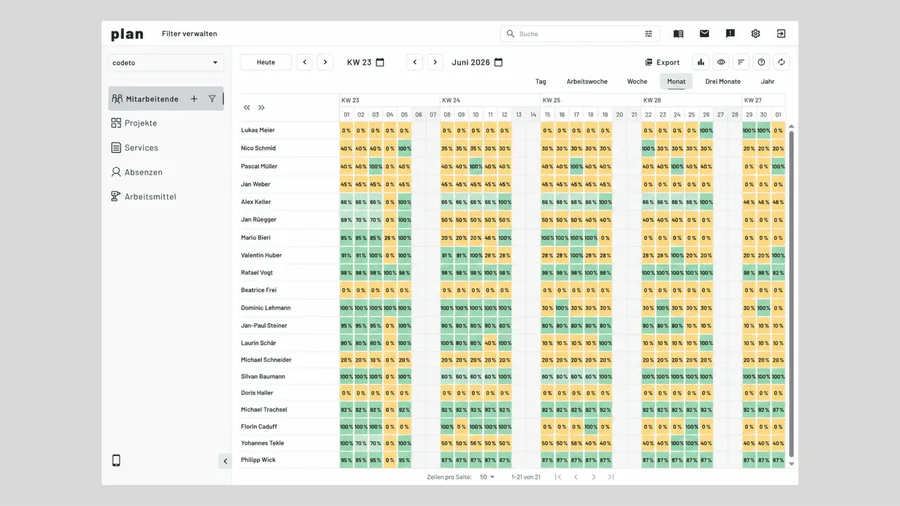
A workload overview shows, for every employee, how high the load is, depending on the chosen view per day, week, month or year. Colours immediately reveal where it gets tight and where there is reserve. As soon as someone exceeds a hundred percent, the cell turns red.
The system does not prevent overbooking. You can deliberately schedule someone beyond their target hours when needed. It simply makes the overload visible instead of hiding it. If you see red, more work has been distributed than the stored target hours allow, and you decide for yourself whether it stays that way.
This noticeably changes personnel planning. Instead of grabbing the next free name, you see who realistically still has capacity. A short-notice absence can be absorbed where there is still room. And idle time becomes visible before it turns into a silent cost factor.
What companies actually gain
When it is clear who is scheduled how heavily and when, many follow-up questions and phone calls disappear. Planning becomes a shared basis, especially when technicians are on the road and see the mobile schedule directly on their phone.
Anyone who knows their own workload can give customers a realistic sense of what is feasible and what is not. In the end, that creates more commitment than saying yes to every job right away.
And it is also about the team. When work is reasonably evenly distributed and overload shows up early, people feel more fairly treated. In an industry short on skilled workers, that is one more reason to stay.